.png)
Chow (51%) Swamps Bradford (34%) and Alexander (9%) in Race for Toronto Mayor



Most voters want change, but Bradford and Alexander aren't winning them over.
Toronto, Canada, September 29, 2026 – With just under four weeks to go until Toronto's municipal election, a new Canada Pulse Insights poll for Rogers CityNews shows Mayor Olivia Chow leading her closest rival, City Councillor Brad Bradford, by 17 points among decided voters. Chow has 51% support, Bradford 34%, and former Conservative cabinet minister Chris Alexander 9%. Another 6% would choose a different candidate. One in five voters (20%) are still undecided.
A majority of Torontonians (55%) say it's time for a new mayor, while just under half (45%) say Mayor Chow deserves to be re-elected. As in every election, the central question is how much appetite there is for change, and how much of it a rival candidate can win over by making the case that they will deliver it.
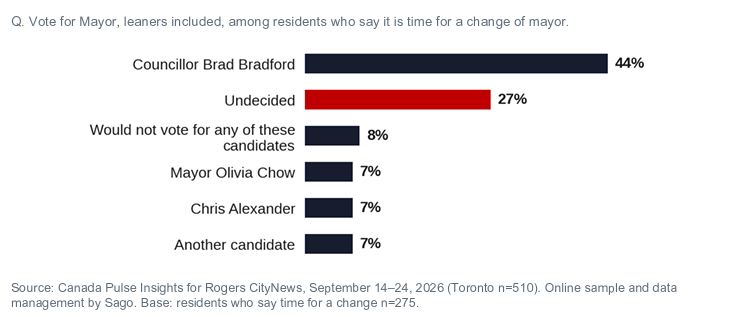
Among those who want change, Bradford has won over the largest share (44%), while Alexander is not even close as a potential change agent (7%). A further 7% want change but still plan to vote for Mayor Chow, an equal number (7%) choose another candidate, and 8% say they won't vote for any of the candidates.
That leaves almost three-in-ten (27%, or 15% of all Torontonians) still undecided about who to vote for, which helps explain the gap between the frontrunner and her closest rival. Vexed, they are also less likely to say they will definitely vote.
Bradford most needs these undecided change agent voters but so far it appears he isn't connecting with them. They share his criticisms of city hall and are just as likely to say it's out of touch, but they are less driven to unseat the mayor. They also look different from his base: they are more likely to be middle-aged (35 to 64) and somewhat more likely to be women. They are also less likely to be married or living common-law, less likely to be white, and more likely to live downtown. As such, their reluctance to back him appears to be less about his pitch and more about fit.
The bottom line: This group wants change but hasn't found a candidate to deliver it, which helps explain the gap between Chow and Bradford. Bradford is currently the main change candidate in this showdown, but whether these voters warm to him as their standard-bearer, return to Chow, or stay home will shape the final result.
Key findings
- 51% of decided Toronto voters name Mayor Olivia Chow; Councillor Brad Bradford trails by 17 points at 34%, and Chris Alexander has 9
- 20% of all Toronto voters are still undecided; 6% would not vote for any of these candidates.
- 55% say it's time for a change of mayor; 45% say Mayor Chow deserves to be re-elected. 46% say the city is headed in the right direction, 54% wrong track.
- 27% of Torontonians who want change — 15% of all Torontonians — haven't picked a candidate.
- 44% of residents who want change would vote for Bradford; 7% would still vote for Chow and 7% for Alexander.
Chow leads with 38% of all voters and 51% of decided voters; 20% are undecided
Among all Toronto voters, Chow has 38%, Bradford 25% and Alexander 7%. Another 4% would choose a different candidate, 6% would not vote for any of these candidates, and 20% don't know. Among decided voters — those who name a candidate — Chow has 51%, Bradford 34%, Alexander 9% and another candidate 6%.
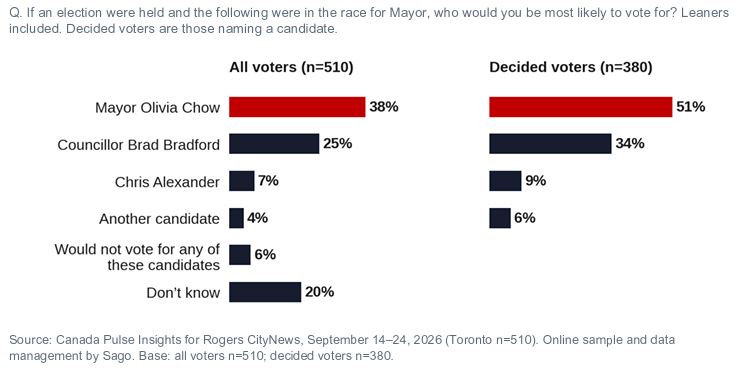
In the June 2023 by-election, Chow was elected with 37.2% of the vote. The municipal election is Monday, October 26, with advance polls from Tuesday, October 6 to Sunday, October 11.
A majority (55%) say it's time for a change of mayor; 45% say Chow deserves to be re-elected
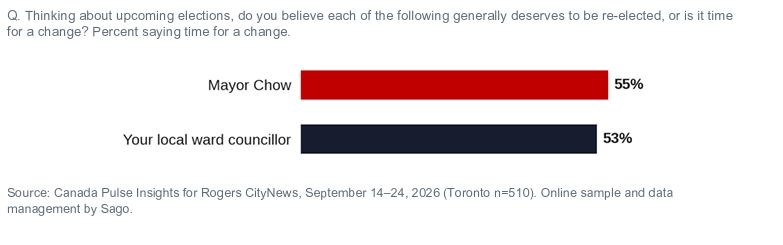
A majority (55%) of Torontonians say it's time for a change of mayor; 45% say Mayor Chow deserves to be re-elected. On their own ward councillor, 53% say time for a change and 47% deserves re-election.
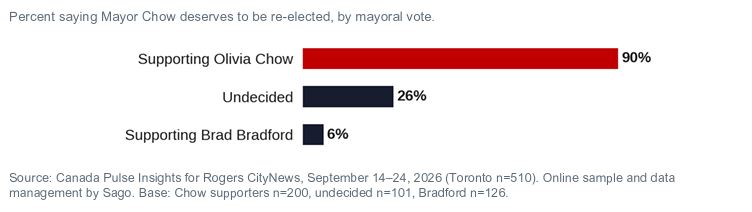
Among those supporting Chow, 90% say she deserves to be re-elected; among those supporting Bradford, 6% do. Among undecided voters, 26% say she deserves to be re-elected and 74% say it's time for a change.
Residents are divided: 46% say right direction, 54% wrong track
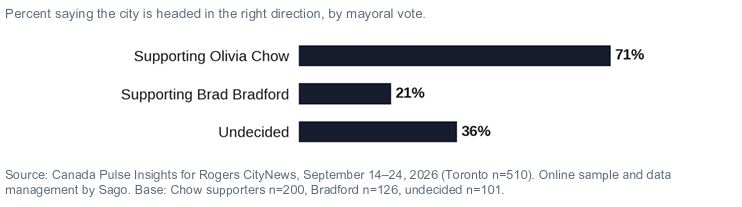
Asked about the city's direction, 46% of Torontonians say it's headed in the right direction and 54% say it's off on the wrong track.
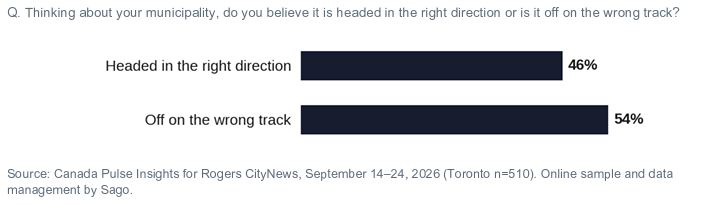
Among those supporting Chow, 71% say the city is headed in the right direction; among those supporting Bradford, 21% do, and among undecided voters, 36%.
27% of those who want change — 15% of all Torontonians — haven't chosen a change agent candidate, and might stay that way
Among the 55% of Torontonians who say it's time for a change, Bradford has 44% of that group with the difference split between those voting for Alexander (7%), another candidate (7%), and another group (7%) who want change but would still vote for Mayor Chow. The remaining group comprise 27% who haven't decided who to vote for and 8% would not vote for any of these candidates.
Compared with residents who want change and have chosen a candidate, those who haven't are more often aged 35 to 64 (63% vs 44%), about as often women (60% vs 52%), less often married or living common-law (37% vs 60%), less often white (38% vs 59%) and more often downtown (20% vs 10%). They are as likely to say city hall is out of touch (79% vs 81%), less likely to want the police budget increased (22% vs 36%), more likely to say Chow is doing a good job (31% vs 19%) and less likely to say they will very definitely vote (62% vs 81%).
About the Survey
This survey was conducted among adult (18+) residents of the City of Toronto (n=510) in Ontario by Canada Pulse Insights between September 14 and 24, 2026. A random sample of adult respondents was invited to complete the survey through an online panel platform managed by SAGO one of the world’s largest and most respected sample and panel suppliers. The data were weighted to 2021 Census benchmarks, so the sample aligns with the city’s adult population by age and gender. Vote intention figures include respondents who were undecided when first asked and then named a candidate they are leaning toward; “decided voters” are all respondents who name a candidate. The margin of error for a probability-based sample of this size is ±4.3 percentage points, 19 times out of 20. Any discrepancies between the detailed tables and published results are due to rounding.
Both Canada Pulse Insights and Sago are accredited members of the Canadian Research Insights Council (CRIC) and adhere to its Canadian Code of Market, Opinion, and Social Research and Data Analytics, which incorporates international ESOMAR standards and Canadian public opinion disclosure requirements. The detailed tables and full question wording for this survey are posted on the Canada Pulse Insights website as a companion to this release, consistent with CRIC’s transparency standards for research released into the public domain.
For further information:
John Wright, CEO, Canada Pulse Insights
Email: johnwright@canadapulseinsights.com
Phone: 416-700-4218
Website: CanadaPulseInsights.com